Archive for the ‘Voxeo’ Category

“It’s the API, stupid!”

Monday, April 15th, 2013

In a recent discussion about “the cloud”, someone told me that he felt the topic was vastly overrated, and that what amounted to time-shared access to mainframes really was a revival of forty year-old concepts. The key thing that struck me about this was how completely it missed the point of a cloud architecture.
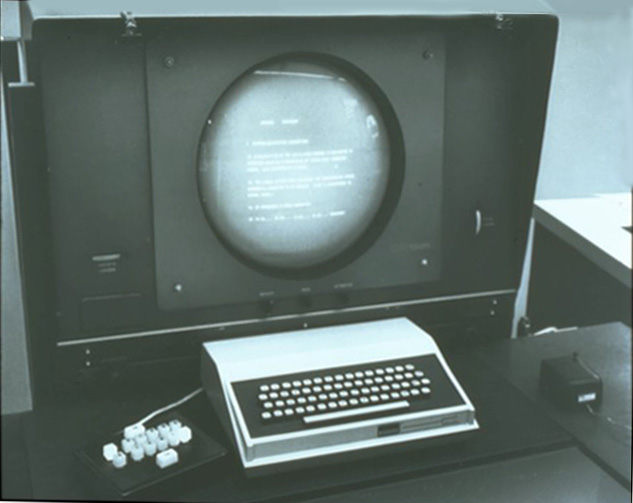
Sure, there is a component of “time-shared access” specifically in the commercial model of paying only for what is used. But the essence of its on-demand nature is the ability to create resources effectively from nothing. Where formerly you had to get a hold of an actual hardware box, wire it up, configure it – you now make a software request and your machine is up and running.

Hardware has become software – and the key is the interface. To borrow from the famous Clinton campaign motto: It’s the API, stupid!

By exposing its capabilities in a comprehensive yet easy-to-use interface, platforms such as Amazon’s AWS go vastly beyond simple “hosted virtual machines” and give full control to developers and their applications.

So we take no small amount of pride in the fact that the Voxeo CXP platform offers its own comprehensive API since 2005, when it was still known as VoiceObjects X5. Back then, before something like EC2 existed, the idea of exposing a platform’s full feature set in a well-documented interface that developers could use was pretty new. And it was driven by our deep conviction that the platform’s task is to serve the applications running on it – not the other way around.

Thus we enabled developers to monitor deployments, as well as to create new ones. To inspect and export applications and object definitions, as well as to import and modify newly developed ones. To adjust user management settings, as well as to add new users or entire tenant sets in multi-tenant environments. We refactored the platform on an “API first” basis, i.e. for each new feature the foremost question to ask was: How is it accessible in the interface?

While the Voxeo CXP API has been augmented over time to cover new platform capabilities, and has been expanded from its original SOAP flavor to also offer a REST version, is has been a staple ever since it first entered the product. And while over time we have added many other market-leading features, such as most recently Hotspot Analytics, there has never been the slightest doubt in our minds that the API was one of the most important platform capabilities we’ve built.

All the more so because we’ve also put our effort where our mouth is: Not only does the CXP Developer IDE use this API to communicate with the platform, it is also the key component used by our extensive Python-based testing framework that puts CXP Server through its paces every night, with every build. Automated testing that ensures the platform’s stability, performance, and reliability – and that is possible only because every single capability is accessible.

For our online documentation of the API, visit http://help.voxeo.com/go/vox/webservices. And as always, we encourage you to share your comments on Twitter – connect @voxeostefan !

Agile bug tracking with Skype

Monday, April 1st, 2013

Typically, our blog posts deal with new features in our CXP product, or with best practices in how to build applications on the platform. This time, however, we want to open the kimono a little and share some development process best practices that enable us to deliver releases independent experts call the “most significant technological advancement within the enterprise communications industry“.

Being a truly international company with offices on multiple continents and distributed development teams, we use online communication tools a lot to stay in touch by chat, voice calls, or video conferences – tools such as Skype. And still it took some creative thinking outside the box to leverage Skype for an altogether different use case – creative thinking that as “passionate problem solving” is one of our core corporate values.

Everybody who has worked in professional software development knows that one of the most crucial pieces of infrastructure is a good bug tracking system. To stay on top of issues, and to ensure their timely resolution, key requirements are:

  • easy access for everybody involved in the development process;
  • good prioritization to focus on the important and/or urgent;
  • convenient search functionality to find existing entries;
  • good handling of supplemental resources (log files, screenshots, etc.);
  • notifications alerting relevant parties of ticket updates.

It was a true “Eureka!” moment when we realized that to get all of this we didn’t need yet another additional system – we could get it, and much more, from the Skype chats we were already using to ensure unlocked communication!

So how do we do it?
All of our developers, testers, and other relevant or interested parties (e.g. Product Management) are in a shared Bug Tracking chat. Any issue that is found is posted to this chat, and its unique time stamp serves as “ticket” identifier. Supplemental resources such as log packages, screenshots, etc. can also easily be posted and shared in the chat and are available to everybody else.
Interactions are automatically persisted in the chat history, and can be consulted again at any later time by straightforward searches. Replication of the information to each client, DNS-like, comes for free!

Notifications on any new entry or update are automatic, and even configurable in the Skype client – including filter settings that let developers target issues in specific product components they’re responsible for through appropriate key words. A great functionality that is hard to find in other bug tracking systems, and that has given us a measurable efficiency boost.

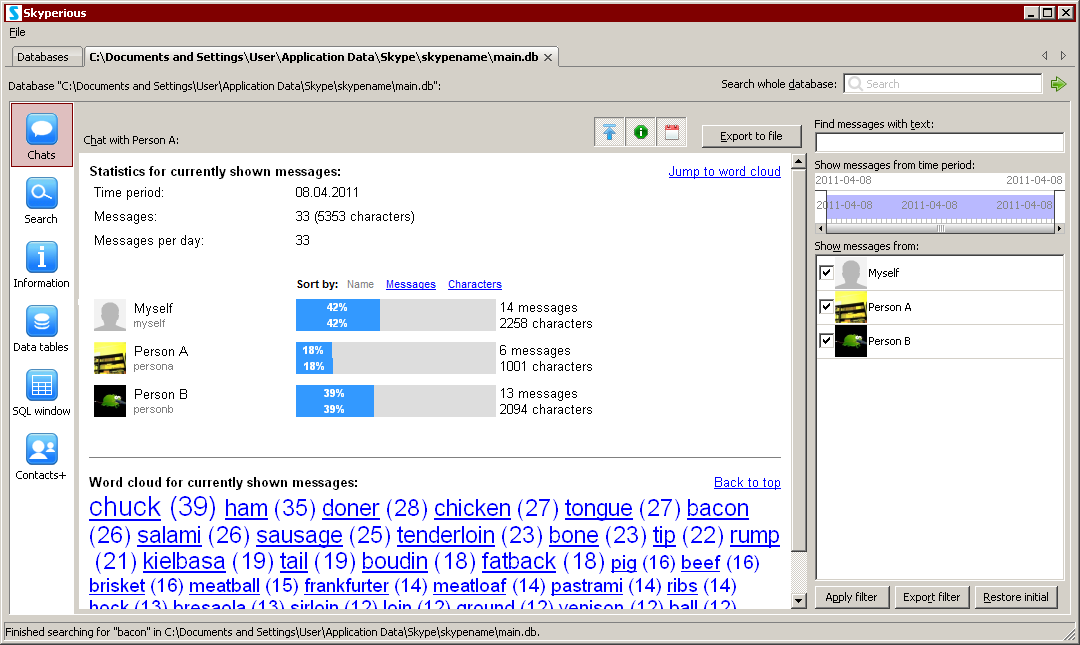
In addition to the regular Skype clients, many of us also use additional tools such as Skyperious that provide even more fine-grained control and advanced search functionality. It also powers the unique way we do “ticket” prioritization – by word cloud!

Instead of having somebody with potentially limited insight into the issue arbitrarily assign some priority, this method ensures that priority emerges naturally, in a “wisdom of crowds” manner, from the work that those who know what they are doing perform on the issues. It has sharpened and aligned our priorities in ways we had not formerly considered possible.

We have been using this approach for about 7 months now, and the results we’ve had are nothing short of amazing. It matches our high-powered agile development methodology perfectly, drives extremely effective sprints, and empowered us to do things for our upcoming CXP 13 release that simply would not have been possible with any legacy bug tracking solution. (To learn more, join Tobias Goebel’s webinar on April 9.)

That one flash of insight has opened the door to a better way of engineering, and we’ve never looked back!

We hope this bit of behind-the-scenes insight has been of interest to you, and perhaps even provided some inspiration for how to optimize your own processes. Let us know what you think on Twitter @voxeostefan – we’d love to hear your success stories!

VoiceObjects 12 adds revolutionary Nuvelld Queue

Sunday, April 1st, 2012

When Gustav Nuvelld, the reclusive Swedish mathematician of the early twentieth century, published his singular masterpiece “On the parameterization of collapsible Hilbert spaces” in 1912, few of his colleagues took any note. When he died just a few months later in a boat accident the details of which could never be fully explained, nobody cared; his body was never found.
Only years later, with the works of celebrated physicists like Schrödinger, Planck, and Dirac would it become apparent in hindsight how far ahead of his contemporaries Nuvelld had really been. Einstein himself was quoted as saying that “If Nuvelld had lived to see quantum mechanics, we would be a lot closer to a Grand Unified Theory!”

Explaining his profound work in layman’s terms is almost impossible, yet the most important practical application of these penetrating insights is the counter-intuitive ability to almost arbitrarily speed up waiting in line – similar in nature to the famous befuddling Banach-Tarski paradox.

Now, a hundred years after its inventor’s death, Voxeo celebrates Nuvelld’s legacy by introducing the Nuvelld Queue to VoiceObjects 12. It represents a stunning breakthrough in performance for the Infostore usage data repository and is, to the best of our knowledge, the first product implementation using Nuvelld’s principles. It comes after years of internal research and countless prototypes tested, tuned, and polished by our best engineers.

Simply stated, the Nuvelld Queue gives you virtually unlimited scalability at constant performance and throughput. Whether you run 30 ports or 30,000 – with the Nuvelld Queue, Infostore data flows in a swift steady stream. Real-time data collection becomes feasible where formerly nightly dumps dominated.

This is great news for our many major enterprise customers who run ever-increasing amounts of traffic from voice, text and web channels on our systems and rely on rapid, integrated reporting. But even if your present needs are not yet as ambitious, you can still benefit.

Interested in drinking from the fire hose? VoiceObjects 12 will be made available to select customers and partners in a pre-release version soon. Let us know if you want in on the action! To secure your place, or for questions and comments, reach out to me on Twitter at @voxeostefan!

Separation of concerns

Friday, March 23rd, 2012

Voxeo’s VoiceObjects lifecycle management platform is used by many large enterprises in various industries to build, run, analyze, and maintain their phone applications. Clearly then VoiceObjects needs to integrate with these organizations’ IT processes designed to protect both the internal integrity and stability of services, as well as caller’s data (specifically in environments dealing e.g. with credit card or other sensitive data).

In this article, I’ll look at how VoiceObjects supports some of these IT processes with a focus on access control and user management.

Development and Deployment

Typically, and for good reason, there is a fairly strict separation between the development of applications and their production deployment. After building, testing, and validating an application it is important that it goes into production unaltered. And once in production, it is crucial that no unplanned and unauthorized changes are made so as not to cause accidental yet costly outages.

On the development side, VoiceObjects provides the core role of a Designer. Designers work in Desktop for Eclipse to build applications, either alone or in teams, supported by collaborative development mechanisms such as object locking and versioning. Service Controllers are a slightly more elevated development-focused role; they can also deploy their applications within tightly defined boundaries in order to test them.

On the deployment side, the Server Controller is the key role. They have control of all deployment and monitoring capabilities, but cannot make changes to applications.

While strict separation is ideal in theory, “let me take a look” is of course routinely heard in practice and often inevitable for timely resolution of problem situations. So how can this be done safely? VoiceObjects provides the read-only user roles of Reviewer and Observer.
Reviewers can inspect projects and even leave comments for developers, yet they cannot make any changes to the applications themselves. This role is often used for Quality Assurance team members, or project managers.
Observers have read-only access to a deployment’s Control Center and can inspect call traffic, logs, error messages, and so on. Developers frequently have Observer access to production deployments, so they can assist with problems but cannot accidentally impact the system.

Four-Eye Principle

Another pair of tasks that are often kept separate is the administration of user accounts, and the actual operational work done with these accounts. This is particularly true in environments dealing with sensitive customer data (e.g. credit cards, bank accounts, etc.). One of the goals is to prevent rogue users from creating arbitrary new accounts for themselves, which they can then use to access protected information. To counter such attempts, VoiceObjects supports the “four-eye principle”.

The role of User Manager has been created specifically to work with user objects, and user objects only. When one User Manager creates a new user object, or modifies an existing one, this action needs to be cross-checked and approved by a second User Manager (or higher role) in order for the modification to be activated.

Independent of the specific user role, VoiceObjects also supports the delivery of credentials directly to users by email. This adds another level of indirection in that those creating or modifying a user object never get to see the password, which is automatically created by VoiceObjects. Additional policies control when and how often users can or need to change their password, which password strings are acceptable, and so on. Finally, an integration with existing user management frameworks (such as LDAP) is also possible.

Departmental Access

Large organizations sometimes want to use shared infrastructure differently in different departments, or in different regional offices. Still the central IT team needs to remain in charge of the overall installation and the collective set of deployments. Setups of this nature are ideally covered by the VoiceObjects Site concept of multi-tenancy.

Each site, corresponding to a department or regional office in the examples mentioned above, has its own sandbox within the single, enterprise-wide VoiceObjects installation. Within each such sandbox, all of the principles listed above can be employed, and full trees of users can be created and maintained. This enables each department, if necessary and desired, to maintain its own development/QA/deployment teams. They have full access to their own projects while being shielded from what other departments are doing. Each department can focus on their own work without the risk of impacting others, while IT can stay in control of the overall system.

In this setup, the Site Administrator role corresponds to the one in charge of each individual sandbox; the Server Administrator at the top corresponds to the central IT team managing the enterprise-wide VoiceObjects installation.

You can find all the details on VoiceObjects User Management in chapters 2 and 3 of the Administration Guide (PDF).

For questions and comments, reach out to me on Twitter at @voxeostefan!

Become a Voxeon – We are hiring in EMEA

Wednesday, July 27th, 2011

We are hiring in EMEA:

You are looking for a new opportunity in one of these areas? Please send us your resume with the job name you are referring to [email protected].

Looking forward to hearing from you!